Kindred Reading Series September: K. Tempest Bradford (that’s me!) & Ibi Zoboi

Next month I have the pleasure of reading alongside Ibi Zoboi at the Kindred Reading Series. September’s reading will take place at Bluestockings Books in New York City and it starts at 7PM.

I will likely read my story from Dark Faith: Invocations and maybe a teaser from “Uncertainty Principle”, my story in Diverse Energies. But, who knows, I may change my mind :)

I don’t know if I’ve mentioned the Kindred Reading Series here before, but it’s the brainchild of Jenn Brissett, an African-American writer from Brooklyn. She wanted to create a reading series for genre writers of color since there’s a general misconception that POC don’t write or read science fiction, fantasy or horror.

A secondary goal was to raise money for the Octavia E. Butler scholarship which helps writers of color attend Clarion and Clarion West, two intensive writing workshops for new authors.

If you’re in the New York area the last week of September, please drop by!

Putting a hard line between art, science, commerce, and creativity

Putting a hard line between art, science, commerce, and creativity

Earlier this summer I read a book by Jonah Lehrer called Imagine: How Creativity Works after reading a snippet of the book in a magazine or on a blog. Read the whole thing, loved it, recommended it to friends. And then a few weeks ago the world finds out that Lehrer did a very bad thing by making up or improperly smashing together quotes from Bob Dylan in said book.

It called all of the facts in the book into question (and since then people have found other errors in other chapters) and rightly cost Lehrer his job at the New Yorker and the respect of fellow writers and readers. I still think there are some good aspects of the book, but I recognize now that the conclusions have to be taken more as Lehrer’s conjectures or opinions.

In reading all the linked blog posts about this scandal, I came across this review of the book, published many months before said scandal. This was held up as an example of people calling shenanigans on Lehrer long before the Bob Dylan stuff was revealed. But as I read the review, I found it to be full of a huge dose of bullshit as well as what seems a real personal anger at Lehrer and all writers like him1:

IMAGINE is a collection of stories—all pop-science these days must be translated into stories, as if readers, like children, cannot absorb the material any other way2.

Lehrer does not see creativity or imagination as being intricately connected to art, or to science, or to anything that we would generally term “imaginative.” It is all about success. … Lehrer’s unwillingness to distinguish between these types of thinking, between art, science, and commerce, is discouraging. Inside or outside, the only place that finally interests Lehrer is the marketplace. …the problem of differentiating between artistic distinction and commercial distinction is especially problematic here. …if you are trying to explain the most ambitious and the most admirable exertions of human imagination and intelligence, some disaggregation, some discrimination, is necessary.

To start, I disagree with Isaac Chotiner’s assessment of Lehrer’s points and that all that interests him is the marketplace.

I heavily contest that one has to distinguish between art, science and commerce when in a discussion of creative thinking.

I always think of the book A Beautiful Mind when stuff like this comes up. It’s about the life of John Forbes Nash, the brilliant mathematician who struggled with paranoid schizophrenia for many years. In the prologue, the author recounts a day when a friend of Nash’s came to visit him in the hospital.

The friend asked: “How could you, a mathematician, a man devoted to reason and logical proof… believe that extraterrestrials are sending you messages?”

Nash’s answer: “Because the ideas I had about supernatural beings came to me the same way that my mathematical ideas did. So I took them seriously.”

As a writer, I often get flashes of insight or inspiration that seem to come from a part of my brain not entirely connected to the conscious part I’m aware of. I love when this happens because it usually leads to great stories. When I read that quote I realized for the first time that this happens to scientists as well.

Not that all great scientific discoveries are the result of this, but that ideas that then collide with your knowledge, understanding and experience come from a part of the mind that’s not readily accessible (like memory) happens not just to artists was very eye-opening for me. It made me realize that art and science aren’t on opposite ends of a spectrum.

Thus, I roll my eyes at Mr. Chotiner and his disdain for narrative and his assertion that just can mix up art and science and commerce and stuff because REASONS.

Whatever Lehrer’s crimes with this book, this isn’t one of them.

Thoughts?


Footnotes

  1. I found that many journalists and older writers had a huge hate hard-on for Lehrer for years. They are way too gleeful over his downfall. []
  2. Dude, narrative is a building block of our culture. It’s not just for children. If you don’t understand that, how can I trust you to review books, even of the non-fiction variety? []

Coming Soon: My stories in Dark Faith: Invocations and Diverse Energies

Those of you who view the blog proper may notice a couple new covers on the sidebar. I have stories in two anthologies coming out this fall and I’m very excited about both.

Dark Faith Invocations

The first one to come out will be Dark Faith: Invocations. From the Apex website:

Religion, science, magic, love, family — everyone believes in something, and that faith pulls us through the darkness and the light. The second coming of Dark Faith cries from the depths with 26 stories of sacrifice and redemption.

My story is “The Birth of Pegasus”. The full TOC is here and includes such awesome authors as Nisi Shawl, Jeffrey Ford and Tim Pratt. It launches at WorldCon in Chicago. If you won’t be there but want to pre-order a copy, click here. (You can get 10% off with coupon code: DFBradford)


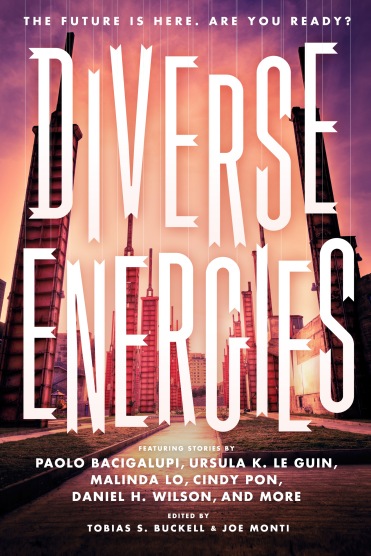
Next is Diverse Energies, a YA dystopian anthology where all the stories feature characters of color. It will be out in October. I’m sharing a TOC with Ursula K LeGuin. I have not yet stopped doing the boggie about that.

You can’t pre-order Diverse Energies yet but I’ll let you know when you can.

What do you think of the covers?

NYC Group Writing Evenings?

NYC Group Writing Evenings?

I don’t get to have many group writing days, anymore, partially due to me not organizing them and the folks who used to do them with me don’t as much, anymore. Or they’ve moved away1. But now that I have a semi-regular schedule again that does not involve working into the night for no good reason, I’d like to try having them again.

During NaNoWriMo I organized a big write-in at Vagabond Cafe and really enjoyed it. Wondering if people in NYC would be interested in weekly write-ins. Perhaps not on such a large scale as NaNo ones, but groups of 5 – 10 folks all dedicated to writing for an hour or two together on a regular-ish basis. I’m sure we can accommodate more if more people are interested and show up.

Vagabond is a good location if we have a smaller group and want to do Tuesday since that’s the night they’re slowest and have no live music. For other days (Monday, maybe Thursday?) I suggest a new cafe called Irving Farm on the upper west side. They have a huge space in the back and are often very empty in the evenings. They serve beer and wine, which is always a bonus.

The kind of writing evening I envision is one where people trickle in for the first half hour, get drinks, food, etc. and chat a bit, then we get down to the SRS bizness of writing. No talking, the whole thing. Maybe we’d do a no talking, heads down sprint in 30 minute chunks then take breaks.

I’m open to ideas about how the writing evening should be structured and any other details. Discuss in the comments and let me know if you’re interested!


Footnotes

  1. Eugene! []

Mental Noodling About Color, Ancient Peoples, and Alien Races

Mental Noodling About Color, Ancient Peoples, and Alien Races

Do any of you out there ever listen to RadioLab, a radio show that broadcasts on NPR stations? It’s a really fabulous show and podcast that’s best described as similar to This American Life but with stories about science and cool stuff instead of just about people’s inner lives. Except the explorations of science and geeky stuff often also includes stories of people’s inner lives. It’s a pretty sweet show.

The most recent episode is called Colors and is an exploration about a bunch of stuff about color. I know, what a surprise. My favorite section is the last one called “Why Isn’t The Sky Blue?” and delves into why the descriptions of color in Homer’s The Iliad and The Odyssey are so… off. The basic explanation is that ancient people saw fewer colors than we see even though they had the physical ability to see more1.

When I first listened to this show I geeked out a bit because I remember hearing this same thing in class back at NYU. How it starts with a long-ago British prime minister noticing that Homer never describes the sky as blue and snowballs into an exploration of how colors come into the human consciousness. My teacher at the time, Scott McPartland, said that the ancient Greeks didn’t see all colors, even though they existed, because they didn’t yet have the imagination to see them. The scientists interviewed on RadioLab have different explanations, but I like Scott’s better.

Scott also stated that two of the traditional rainbow colors are completely made up. That would be Indigo and Orange. These in-between colors were invented to make 7 colors, as 7 is a more perfect or spiritual number.

Yes, this assertion is probably arguable. I remember we argued about it in class a lot. Especially about orange. Apparently before oranges were orange (which they’re bred to be), they were yellow. So we invented oranges to justify orange as a legit color. Fascinating.

Anyway, I bring all this up not just because you should listen to RadioLab or argue with me about the realness of Orange and Indigo, but because I think this is an interesting bit of knowledge to keep in mind if you’re writing about an ancient people. How does your writing change if you can’t use the entire rainbow of colors? Not being able to describe the sky as blue? Or a berry as red or purple? Or the grass and leaves as green? How does that change how your characters see the world and relate to it?

Another cool thing mentioned earlier in the show is that some animals and insects have the ability to see thousands and millions more colors than we can. I’m toying with the idea of an alien race that can see far more colors than we can and how that affects how they relate to us. There is always an assumption that humanoid races pretty much see how we see, but even on our own planet there is a wide range of color seeing ability, thus it’s less likely to be homogeneous across worlds.


Footnotes

  1. Listen to the entire show for an explanation of how our eyes see color. []

Social Media Resources for Sipping From The Firehose #WisCon36

Social Media Resources for Sipping From The Firehose #WisCon36

Just about to head into my next panel, “Sipping From the Firehose: Managing Writing and Social Media,” and wanted to get this list of resources up for those attending and those who are following along via Twitter. The hashtag for this panel is: #SocialMediaSFF.

This post will change slightly as the discussion goes along, and hopefully there will be a panel report or two from the audience I’ll link to.

Social Networks That Are Useful For Writers

These are in a roughly most useful to least useful configuration, but the relative usefulness also depends on what kind of writing and promoting you do. This is not a prescriptive list — every writer does not need to be on every network. This is just a list to consider. After the panel I’ll try to add context for which networks are good for what kinds of activities.

  • Facebook
  • GoodReads
  • LibraryThing
  • Tumblr
  • Twitter
  • Dreamwidth
  • LinkedIn
  • LiveJournal
  • Delicious
  • Flickr
  • Google+
  • Pinterest
  • DeviantArt
  • Reddit
  • StumbleUpon
  • Vimeo
  • YouTube

Social Networking Tools

These are services, apps, and plugins that make dealing with social media a bit easier, especially if you have multiple accounts.

  • Hootsuite — A social media dashboard that puts several social networks in one place. See updates from Twitter, Facebook, LinkedIn, WordPress, Ping.fm and FourSquare from one window. Update multiple accounts at once. Schedule updates for the future. Accessible from any browser and via apps for Android, iPhone and iPad.
  • Tweetchat — Tool that lets you focus on one hashtag at a time. Good for participating in Twitter chats.
  • TweetBot — The best iPhone/iPad Twitter client.
  • TweetCaster — One of the better Twitter clients for Android.
  • RSS Graffiti — Facebook app that posts a status update whenever you update your blog.
  • JournalPress — A WordPress plugin that crossposts to LiveJournal and DreamWidth.

Writing and the Art of Provocation

At last year’s Readercon I participated in a panel called Myth, Midrash, and Misappropriation (actually, I was the leader/moderator) with an interesting group of writers and Claude Lalumière. The panel was supposed to be about the appeals and challenges of creating fiction from a religious source and how to avoid or deal with the dangers of cultural appropriation and/or offending people.

I won’t recap the entire discussion for you, but the major highlight of the panel (for me) was when, in his introduction, Claude announced that the purpose of art is to be offensive or to offend people I can’t remember if he initially said offensive or to offend, but this was definitely the core of his argument. Art should offend! He said more than once until he started to backpedal pretty hard in the middle of the panel.

Not knowing much about Claude before that moment, I was unprepared for the douchewankery he brought to the discussion1. He was unprepared for how hard I would not allow him to get away with that statement or how prepared I was to challenge him on it. And he was super unprepared for how much the audience was not on his side when question time came. That’s when the backpedaling started.

We spent a good deal of time on the panel unpacking that initial statement and talking about all the ways in which it’s completely problematic (along with all the other problematic stuff he said such as how it’s okay for him to use any religious or spiritual trappings from any culture because he’s an atheist, anyway, and doesn’t believe in them oh and also he is from French Canada so he understands what it means to come from an oppressed, occupied culture). I believe it was Jack Haringa who, after initially agreeing with his understanding of what Claude meant, actually came around to something more like: artists may hope to offend if their message is aimed at a group or idea that they find offensive. Writing with an eye toward pointing out a horrible injustice, say. The ones perpetrating that injustice may be offended — good.

I sort of agreed with that as well, but still didn’t feel it was quite the right way to think about art. In the many months since I’ve poked at the idea more and more, but still hadn’t come up with a better way to think about what Jack was getting at. Then last month someone else came along and nailed it.

NPR’s Weekend Edition interviewed National Book Award-winning poet Nikki Finney, and toward the end of that interview she said this:

Art is about being provocative; art is also about beauty and if you leave the latter out, the former doesn’t matter.

I immediately thought: YES, THAT. That is what we were reaching for around the 600 pound gorilla of Claude’s initial statement.

There is no beauty in being offensive. Offending someone, especially when you’re coming from a place of privilege and oppression, is not the basis for great art, for beautiful art, even if the beauty you’re reaching for is terrible and tragic and real.

Consider the context in which Finney made this statement:

As a young poet, I grew up in the ’60s and early ’70s, when difficult things were being said and shouted and screamed,” Finney says. “I remember saying to myself, those things are very, very important to hear, but there must be another way to say them so that they will truly be heard. I mean, that’s what art is. Art is about being provocative; art is also about beauty and if you leave the latter out, the former doesn’t matter.

I haven’t read any of this woman’s poetry yet, but I want to. I feel like she can teach me the art of saying difficult things. I am often among those who say and shout and scream because that’s important, too. And I know for a fact that engaging in this mode of discourse does result in being heard, because I often have conversations with people who listened and appreciate it. But I’d also like to be adept at that other way she speaks of.


Footnotes

  1. Later, when I related the goings on to others, several people said “Oh, you didn’t know? Claude Lalumiere is a total douchecanoe.” No one warned me! []

Tempest’s WisCon 36 Panel and Party Schedule

Tempest's WisCon 36 Panel and Party Schedule

WisCon 36 is almost upon us. Here’s where I’ll be!

Parties

Riots of Bloom | Sat, 9:00 pm Room 607

I’m the DJ.

Join us for spicy samosas and wine as we dance the night away to world beats! Riots of Bloom is a party to celebrate the speculative fiction of authors of color who have books and stories releasing this year. (N. K. Jemisin, Neesha Meminger, Kiini Salaam, Ibi Zoboi, Alaya Dawn Johnson) We are especially honored to celebrate WisCon 36 Guest of Honor and Tiptree winner, Andrea Hairston! So put on your most riotous colors and come prepared to boogie on down to the rhythmic beats of reggae, calypso, salsa, bhangra, and other world music!

Unnamed, not on the schedule shenanigans | Friday 11:00 pm room TBD

So there has been talk for a while about doing a party wherein we watch and heavily criticize Jem! and My Little Pony and some other beloved cartoons of our child and adulthood while eating gummi bears soaked in rum, vodka flavored with Skittles, and a number of other ridiculous, not safe for kids foods. Given the nature of the foods in question, it was suggested to me that we NOT make this an official party. So we’re going to find a suitable space and have it semi-privately.

Panels

From Sherlock to Sheldon: Asexuality and Asexual Characters in SF/F
Fri, 4:00–5:15 pm | Senate B

K. Tempest Bradford (mod), Liz Argall, Dawn Ash, L J Geoffrion, Jed Hartman

We’re all familiar by now with the sexual orientations homosexual, heterosexual and bisexual. Much less discussed are asexuals, persons who do not experience sexual attraction. This panel discusses what asexuality is and is not, and proposes ways for authors to explore this overlooked orientation in their characters. Is it enough that a character has no on-page sex life, or should asexuality be more positively portrayed? Asexuality in real-time fandom and asexual characters in fiction and media may also be discussed as time allows.

Feminist Blogging: What Is It and What Role Can It Play in Creating Social Change?
Sat, 10:00–11:15 am | Caucus

K. Tempest Bradford (mod), Brit Mandelo, Andrea Chandler, Michelle Kendall, Rachel Virginia Swirsky

The internet has seen an upsurge in feminist blogs, with those words returning millions of results in search engines. What are feminist blogs? How can feminist blogs help create positive change? In what ways can these spaces model an inclusive, non-hierarchical environment? What are the downsides to feminist blogging? Join us as we discuss new ways the internet can help further the discourse around issues of social and economic justice, feminism, and anti-oppression.

Sipping From the Firehose: Managing Writing and Social Media
Sat, 1:00–2:15 pm | Senate A

K. Tempest Bradford (mod), Barth Anderson, Kimberly Gonzalez, Michael J. “Orange Mike” Lowrey, David J. Schwartz

FaceBook, Google+, LiveJournal, Tumblr, Twitter, blog, traditional website: Does a writer need them all? How do they help with self-promotion? How do they help with the isolation of writing? If you participate in social media, how do you keep it all up-to-date and still find time to write?

Creating Your Own Religion
Sun, 10:00–11:15 pm | Conference 4

K. Tempest Bradford (mod), Ann Leckie, Alex Dally MacFarlane, Deirdre M. Murphy, Larissa N. Niec

Which SF authors create interesting, believable religions, and which get religion wrong? (What does it mean to “get religion wrong” anyway?) Do made-up religions with intervening gods work better than those without? How can we as writers avoid making mistakes when creating and writing about fictional religions?

Not Everyone Lives in the Future
Mon, 10:00–11:15 am | Room 623

Carrie L. Ferguson (mod), K. Tempest Bradford, Ruthanna Emrys, Jesse the K, Na’amen Gobert Tilahun

Technology has an undeniably transformative effect on our lives and it is worth examining who has access to those effects. Geeks are generally very engaged with technology and it is easy to assume that the Internet, cell phones, computers, etc. are a given in everyone’s lives. However, there are large communities where technological access is not at the level that geeks take for granted. How does lack of access to technology impede communities’ ability to prosper? How can geeks help to make technology more available to communities that may benefit from them? Are these transformative effects even desirable? What are good examples of SF that highlight or problematize this issue?

Reading

Title TBA
Sun, 4:00–5:15 pm | Michelangelos

Group reading: K. Tempest Bradford, Alaya Dawn Johnson, Jackie Mierzwa, Larissa N. Niec

Co-Signed: An open letter to Washington from Artists and Creators

From Stop The Wall:

As creative professionals, we experience copyright infringement on a very personal level. Commercial piracy is deeply unfair and pervasive leaks of unreleased films and music regularly interfere with the integrity of our creations. We are grateful for the measures policymakers have enacted to protect our works.

We, along with the rest of society, have benefited immensely from a free and open Internet. It allows us to connect with our fans and reach new audiences. Using social media services like Facebook, Twitter and YouTube, we can communicate directly with millions of fans and interact with them in ways that would have been unimaginable just a few years ago.

We fear that the broad new enforcement powers provided under SOPA and PIPA could be easily abused against legitimate services like those upon which we depend. These bills would allow entire websites to be blocked without due process, causing collateral damage to the legitimate users of the same services – artists and creators like us who would be censored as a result.

Read the whole thing.

As a writer and creator I wholeheartedly co-sign this statement.

Stop piracy, not freedom.

My Thoughts On The Latest #YesGayYA Developments

My Thoughts On The Latest #YesGayYA Developments

I meant to post this yesterday, but work things got in the way. Then the ever-wonderful Cleolinda posted the long, long post I was going to write and said everything I was going to say. So I’ll keep mine short. I suggest you click over to Cleolinda’s blog for the full story. Seriously.

A few days ago Rachel Manija Brown and Sherwood Smith wrote a guest post for the Genreville blog over at Publisher’s Weekly about their experience with an unnamed agent who asked them to make changes to their YA manuscript to erase the fact that a main POV character was gay. At least for the first book in the series. The pair went on to say that they’d heard that this thing with erasing gay characters in YA was something other authors experienced and thus they felt the need to write about it and bring the overall issue to light.

They did not name the agent or agency. They moved on from their specific example to the broader issue. They pointed out that this seemed to come from a concern over market forces rather than labeling anyone Homophobic or Gay Hating. If you don’t believe me, go read the original.

The post sparked a big conversation about the issue and I saw in the comments and on blogs and social networks that several other authors, published and not, talk their stories of having agents and/or editors tell them to remove gay characters from their YA.

Then Joanna Stampfel-Volpe, an agent with Nancy Coffey Literary & Media Representation, posted on Colleen Lindsay’s blog, The Swivet, outing her agency as the one in question (though claims she is not the specific agent in question) and essentially called Rachel and Sherwood liars. Under the guest post part, Colleen added this:

FACT: Both these writers already have their own agents. At least one of those agents reps YA books. So what does it say when the respective agents for both these well-established writers advise them to find a different agent for the book in question because neither of them wanted to rep it themselves?

It tells me that homophobia was most likely not the reason that this book has thus far not found representation.

And that made me see red because that just looks like a personal attack and an attempt to dismiss what Rachel and Sherwood said by saying that their book is no good. Further, on my Facebook page, Colleen claimed that she knew other agents who turned the book down because it had structural issues.

I like and respect Colleen a lot, but I’m calling bullshit on this. Though she says she didn’t mean for the above words to be an attack, that’s what it looks like. And, even if other agents passed on the book for structural reasons, that does not mean that the conversation as represented by Rachel and Sherwood didn’t happen. One does not preclude the other.

Putting that aside, at this point we’ve reached He Said/She Said, and it comes down to which side you believe. Stampfel-Volpe said that at no time did they say they wanted make the character not gay or take away references that he was gay in the book in question1. Rachel and Sherwood maintain that this is indeed what was said.

For my part, I believe Rachel and Sherwood. My main criteria being that my interactions with Rachel online and the interactions and friendships she has with people I know and trust do not lead me to believe she would lie in this way. I don’t know Sherwood well, but nothing I have ever heard from her good friends leads me to believe she would perpetuate a hoax for publicity or lie for profit.

Rose Fox of Genreville apparently felt the same way. Colleen mentions something about how the piece wasn’t fact checked, but how was that supposed to happen? The agency wasn’t named. And even though there are claims that the gossip identified the agency, the majority of us wouldn’t know without their self-outing. These are not the kind of “facts” that can be easily checked because the other party can say “That didn’t happen” and they could be lying just as easily as the authors. Rose used her judgment based on what she knows about the two women and, so far, I haven’t seen any reason for her to have doubted that.

Additionally, Stampfel-Volpe’s post is filled with the kind of red flags I see every day as an anti-prejudice activist. The tone is too defensive2 and unconvincing. Plus, what exactly do you expect the agency to say? “Yes, we did that”? No. Hell no.

Think about it. If they did request the changes Rachel and Sherwood claim and did so because of market forces and such, they wouldn’t admit to it especially if they aren’t homophobic themselves. It’s just like the whole cover controversy with Justine Larbalestier’s Liar. I’m sure that her publishers are not racist people, but they put a non-black person on the cover of her book at first because they assumed that systemic racist attitudes would hurt sales. That is not something you want to admit in public, because it’s gross. It happens, though. We all know it happens. And thanks to #YesGayYA we know that the erasure of gay characters in YA happens, too. And it’s still gross.

No one wants to admit when they give in to prejudiced bullshit.

The other reason I just don’t believe Stampfel-Volpe is that she made this whole thing personal:

One of our agents is being used as a springboard for these authors to gain attention for their project. She is being exploited. But even worse, by basing their entire article on untruths, these authors have exploited the topic.

Someone explain to me how the agent in question is being exploited when he/she wasn’t named. Also, bringing a topic to light is not exploitative. The kind of people I see using language like that are the folks who try to tell me that by bringing up racism or “inventing” it when it’s not there, I am the one being racist. This is a classic defense. It may even be on the BINGO card. When I see people using this kind of language, I immediately distrust what they have to say. I’ve been on the receiving end of this too often to not recognize it.

I suggest you read the original Genreville post and the other excellent links at Cleolinda’s blog before you come down on one side or the other, especially if you don’t know any of the people involved. The readiness of some people to immediate jump to HOAX! based on absolutely nothing but one person’s word would astonish me if I didn’t already have plenty of experience watching people readily dismiss real prejudice that exists right in front of them as not-prejudice. It’s so much more comforting to think that someone is just a lying liar than that there’s a serious problem to tackle.

Tackling problems requires thought, effort, and often sacrifice. Who wants to deal with that?


Footnotes

  1. Edited to make things clearer. I didn’t read my original sentence a second time and should have. Thanks Helen. []
  2. Especially the parts added by Colleen, who emphatically claims that the agent is a good friend and not homophobic, even though Rachel and Sherwood didn’t say he/she was. A person might not be personally homophobic, but still perpetuate the idea that mainstream readers are too homophobic to deal with gay charcaters. It’s a systemic problem, and one need not be personally prejudiced in order to bow to the system. []